Site and Scale: Art Beyond the Gallery Wall
Seven artists who measure space through drawing, sculpture, and intervention, from minimalist marks to landscape transformations.
“20 artists dealing with Environment & Spatial Experience”
This exhibition brings together artists for whom environment and spatial experience are not subjects but materials. Some work at the scale of the hand—Richard Tuttle's obsessive investigations of line, color, and fold on paper negotiate the space between gesture and form. Others claim entire landscapes: Christo's Running Fence projects wrap the California hills in nylon, while Robert Smithson documents geometric interventions and displacement in the desert. Between these extremes sit sculptors who activate rooms with minimal forms (Richard Nonas) and artists working with the wall itself as material (Rodney Alan Greenblat). What unites them is a conviction that art need not depict space or experience—it can construct it, occupy it, measure it, and transform how we move through it.
The work ranges from the private (notebook drawings in watercolor) to the monumental (a fence stretching across counties), from Renaissance engravings that chart spatial relationships through architectural perspective to contemporary interventions. Some pieces are austere; others burst with color. Yet all operate on a principle: that the relation between object and viewer, mark and surface, structure and landscape, is where meaning lives. This is art that asks you to walk around it, look closely at its edges, or imagine yourself standing in a field watching fabric billow across a horizon.
The exhibition traces no single historical arc. Instead, it proposes a conversation among different scales of attention—the microscopic detail, the human body, the architectural room, the open land—each revealing how artists think spatially and how space itself can be an artwork.
Walk through in order, 13 works.
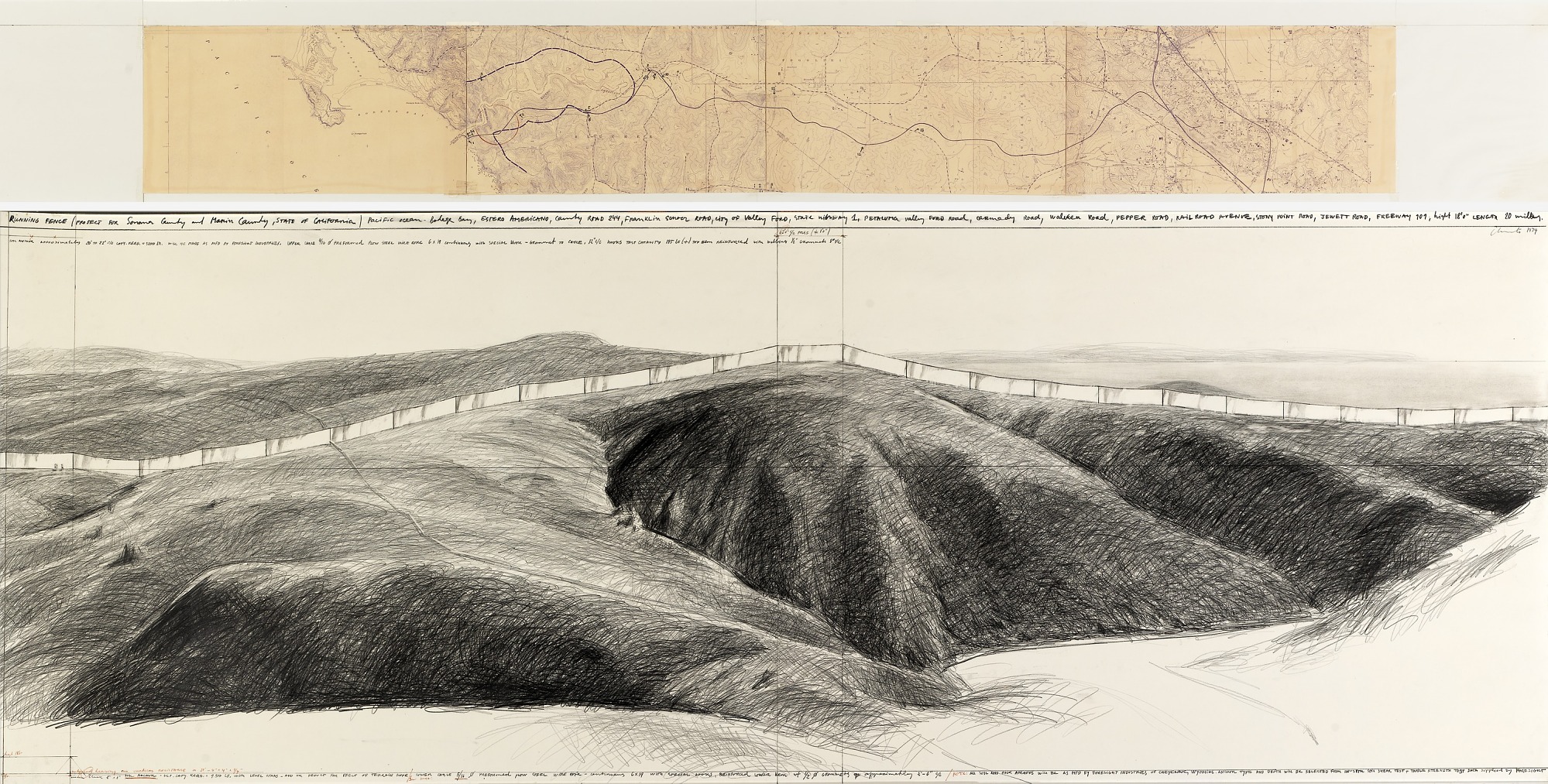
Running Fence (Project for Sonoma County and Marin County, State of California) Pacific Ocean---Bodega Bay, Estero Americano, Country Road 244, Franklin School Road, City of Valley Ford, State Highway 1, Petaluma Valley Ford Road, Carmody Road....
The project drawing maps Christo's proposal across actual landscape coordinates, collapsing aesthetic vision into surveyed geography and asking the viewer to imagine the entire terrain transformed by fabric.
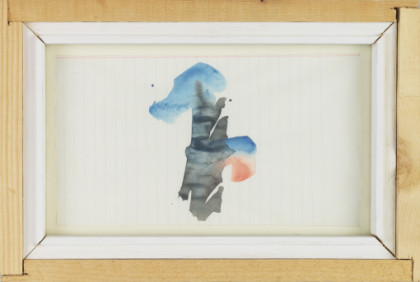
Post - Group II, #4
Tuttle's watercolor on notebook paper exemplifies his practice of finding complexity in the smallest gestures, here, layered washes on industrial graph paper transform mundane office materials into fields of chromatic nuance.
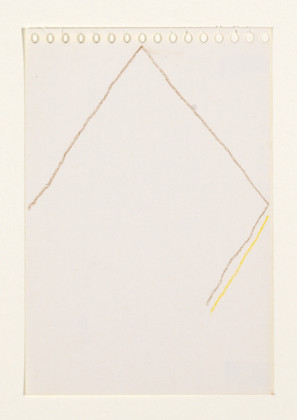
Yellow and Brown Diamond
Two lines of colored marker define a diamond and slope on bare paper, reducing the apparatus of drawing to its essence: the hand's path, the mark's edge, the paper's plane.
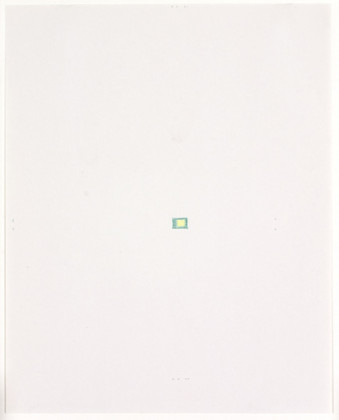
Fort Worth Work 3
A single small green square, rendered in colored pencil on an otherwise blank page, forces the viewer to measure the scale of absence, to experience the white paper itself as space.
Fort Worth Work 4
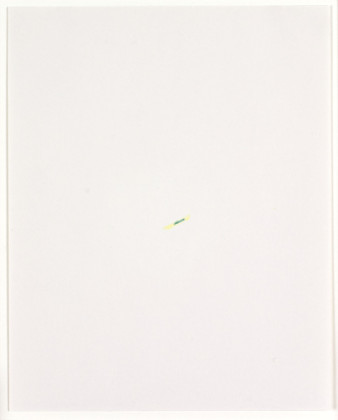
A thin yellow line on white paper again tests how little material is needed to activate the field around it, Tuttle's economy demands that the viewer supply the spatial grammar.
Post - Group I, #1
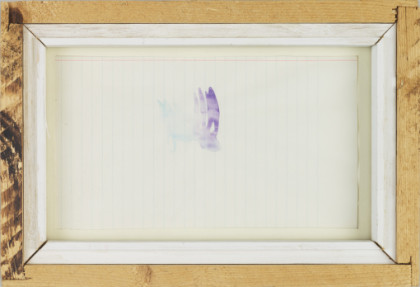
Another watercolor on graph paper, this time with a single purple mark floating in the lined grid, using the paper's inherent structure as a framework against which the gesture registers.
Untitled, 1979
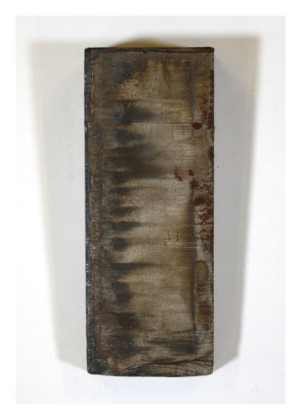
Steel bar, industrial and unadorned, positioned to divide space by its mere presence, Nonas's work shows that sculpture need not announce itself with form, only with the spatial pressure it exerts.
Untitled (?)
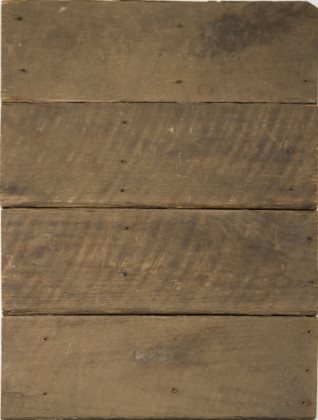
Wooden boards stacked horizontally, each showing the wear of time and handling, occupy the wall through accumulation and weight rather than gesture.
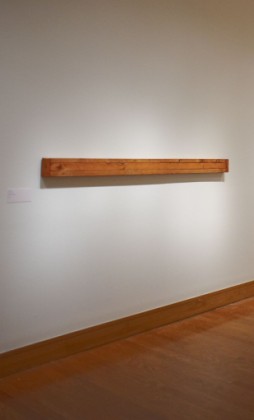
Untitled
Single wooden plank mounted horizontally at eye level, engaging the room through negative space as much as object, Nonas asks how little material is required to claim a wall.
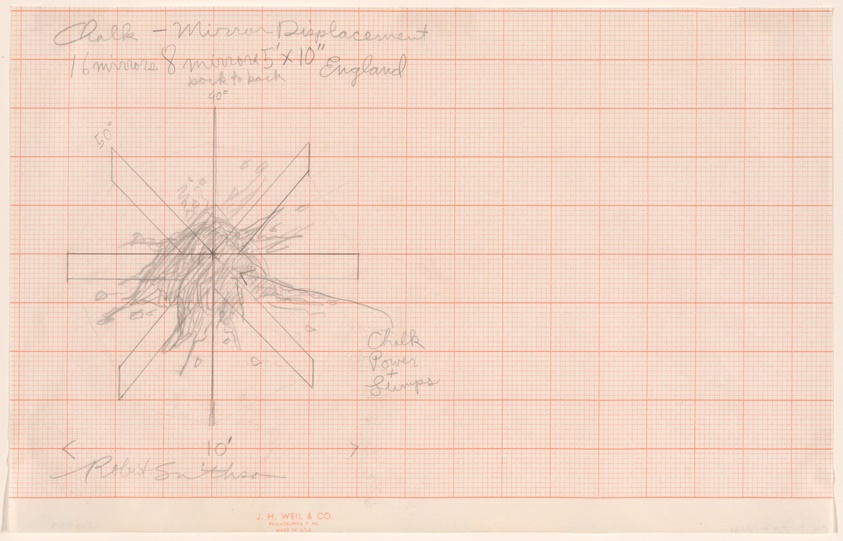
Chalk–Mirror Displacement
Smithson's diagram on graph paper marks a method of spatial analysis, chalk lines on a field offset by displacement vectors, transforming abstract land into measurable, occupied space.
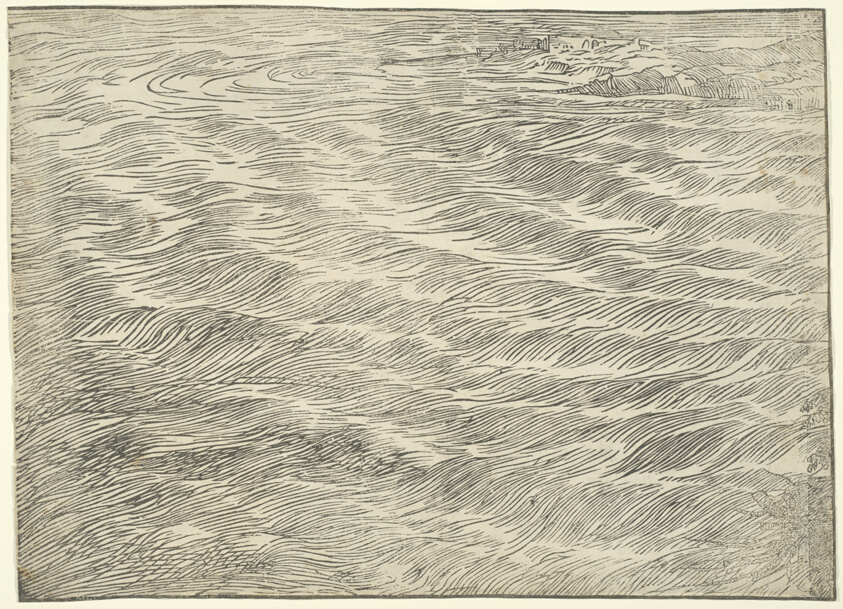
The Submersion of Pharaoh's Army in the Red Sea
Titian's woodcut renders the Red Sea as rhythmic, layered waves that carry both narrative and pure linear patterning, showing how Renaissance masters encoded spatial depth through repetition and line.
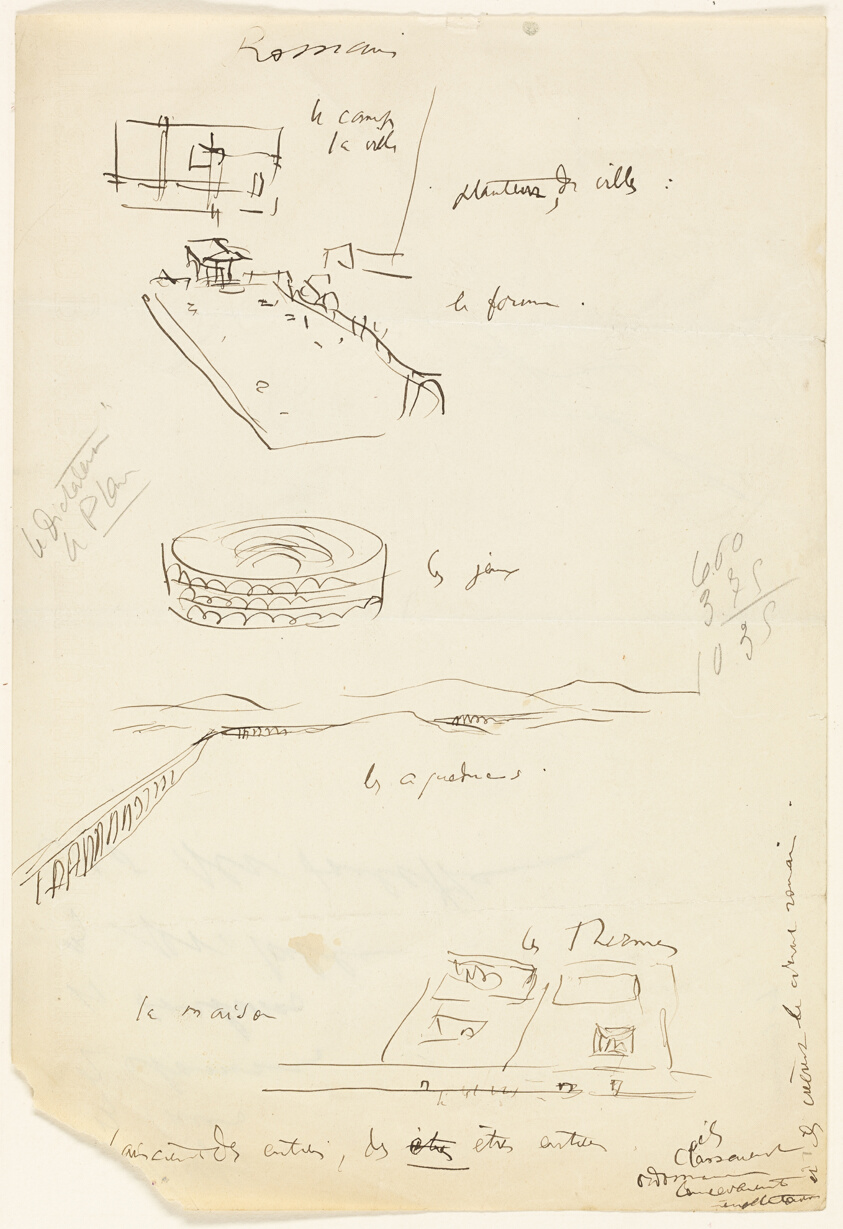
Sketches of Roman Architecture
Le Corbusier's sketches of Roman buildings decode architecture through rapid notation, collapsing millennia of spatial innovation into a few pen strokes, showing that drawing itself can be a tool for understanding how to inhabit space.
Wall Pal
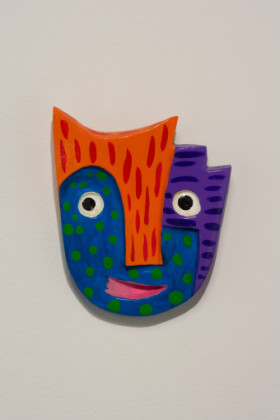
Painted plaster figure mounted on the wall as both sculpture and wall-work, Greenblat's blocky, brightly colored form suggests that art need not be austere to activate a room, color and geometry together claim the wall as spatial material.
The Review

What strikes first about this show is not its conceptual unity but its material honesty. Each of these seven artists appears to have spent considerable time asking: what is the least amount of stuff I can use to make someone aware they are standing in a room?
Tuttle's works occupy the smallest footprint. A green square the size of a postage stamp sits on paper, barely visible unless you stand within inches. A thin yellow line trails off the bottom edge of another sheet. These aren't gestures meant to register from across the gallery. They demand you move close, bend your posture, place your eye at a specific angle. The paper itself becomes part of the work's insistence, the paper is where the work's spatial claims begin, not where they are drawn. When I looked at his watercolors on graph-paper notebooks, I kept thinking about the labor of restraint: how much discipline it must require to mark white space so lightly, knowing that your material won't announce itself to a casual viewer.
Nonas's sculptures operate at the opposite extreme, though with a similar conviction about economy. His steel bar stretches nearly the length of a wall. His wooden boards stack in horizontal registers, showing the grain and weathering of age. Neither piece is decorated or refined in any traditional sense. What interests him is what happens when you place a simple rectangular solid in a room and then refuse to do anything else to it. The steel bar is not sculptural in the conventional sense, it makes no gesture, courts no beauty. It simply inhabits space by being there, by having weight and position and the ability to interrupt your eye. The wooden stack functions the same way, though it holds the addition of time: you can read the surface damage, the slight warping. The object carries a history of use, even though we don't know what it was used for.
Christo's drawing of the Running Fence project exists in this strange middle ground. The pencil marks and charcoal traces overlay an actual topographic map, binding artistic ambition to surveyed reality. You can see the coordinates printed on the paper, the roads named, the terrain rendered as contour lines. Christo's hand moves across this existing spatial language to propose something that would expand to the scale of counties. There's no way to separate the vision from the infrastructure that would be required to build it. The drawing is partly plan, partly prayer.
Smithson's diagram of chalk displacement and Le Corbusier's rapid notations function as tools for thinking about how space is organized and inhabited. Neither is primarily concerned with beauty on the page. Smithson's graph paper is filled with vectors and grid lines meant to be read, not admired. Le Corbusier scribbles classical architecture into abbreviated shorthand, using the page as a working surface rather than a finished one. Both understand drawing as a form of spatial analysis rather than visual refinement.
Greenblat's painted plaster figure is the odd note, and I mean that as observation rather than complaint. Where everyone else in the room is practicing subtraction and spareness, Greenblat uses saturated color and chunky geometric forms. The face is crude and cheerful. It's art that permits itself to be painted, not merely drawn. Yet it sits on the wall with the same spatial logic as everything else: it doesn't try to represent emotion or narrative, only to occupy the plane and force you to acknowledge its material presence.
Titian's woodcut is the historical outlier, a Renaissance rendering of waves that moves through line rather than through any contemporary spatial concern. Yet the energy of those repeated lines, the way the wood block carving builds rhythm through repetition, finds an unexpected kinship with Tuttle's minimal marks and Smithson's diagrams. All three understand that space can be activated through line, through the edge where the mark stops and the paper begins.
The show's weakness is also its strength: by refusing to explain the connections between these works, it leaves the visitor guessing at the curatorial logic. Why Titian? Why is Greenblat's color here? The argument would be stronger if it trusted more fully that spatial experience needs no historical justification. Instead, the presence of a Renaissance print and mid-century sketches pulls the focus backward, as if to say these ideas have always existed. That may be true, but it also diffuses the show's actual urgency, which lives in the contemporary works, in Tuttle's insistence that a single line can activate an entire field, in Nonas's refusal to make sculpture anything other than what it is. The historical reaches feel like scaffolding the show itself doesn't need.
- +Tuttle and Nonas's works generate genuine spatial awareness through extreme material economy
- +The show trusts viewers to find connections between works without didactic hand-holding
- +Christo's drawing method, overlaying vision onto actual topography, offers a rare glimpse of conceptual ambition made visible
- –The historical works (Titian, Le Corbusier) dilute rather than deepen the contemporary argument
- –No clear rationale for why these particular seven artists form a coherent show beyond the general theme
- –The exhibition avoids taking sides on what 'spatial experience' actually means or requires of art
- Carl Andre →Andre's floor sculptures and grid-based arrangements extend the logic of Nonas and Tuttle's spatial minimalism into industrial materials and serial repetition.
- Agnes Martin →Martin's grids and line-based drawings operate at the same threshold between the barely visible and the spatially transformative that defines Tuttle's practice.
- Land Art →Beyond Smithson and Christo, the broader Land Art movement shares this exhibition's conviction that space and landscape are materials artists can work with directly.

Standing in front of Fort Worth Work 3, I'm looking at a green square no larger than a postage stamp on otherwise blank paper. The first critic called this restraint; I'm calling it evasion. The work exists so quietly that you have to decide it matters before you can even see it. That's not spatial investigation, that's delegation of meaning to the viewer's willingness to care.
Tuttle dominates this show, taking up five of the thirteen works, and the repetition reveals something the curatorial statement doesn't want to admit: this is a strategy that diminishes rather than expands. Yellow and Brown Diamond has a tan outline of a quadrilateral with a single yellow line breaking off the edge. Fort Worth Work 4 is a thin yellow mark on white. Post - Group I, #1 shows a purple watercolor brushstroke on graph paper inside a wooden frame. The works form a sequence of near-invisibility. Each successive piece seems designed to disappear further into its support, as if the point is to see how little an artwork can be and still count as one. By the fourth or fifth, I'm not sure I'm looking at art so much as documentation of the artist's hand restraint exercises.
The problem compounds when you place Tuttle next to what the show claims to be about: spatial experience. His works don't expand how you move through a room. They contract your attention to a pinprick. You don't navigate space with Tuttle; you stand still and squint. That's a genuine formal strategy, maybe even an interesting one, but it's the opposite of what the exhibition promises. A true Site and Scale show would be asking how art claims territory, how it reconfigures the body's relationship to distance, how it makes you aware of the ground beneath your feet or the walls around you. Tuttle makes you aware of your eyesight and your patience.
Nonas's wooden stack (Untitled (?)) does something closer to what scale might mean. The piece shows weathered horizontal planks, the grain visible, marks of time embedded in the surface. The wood carries a history, not in the sense of romantic decay but in the literal wear patterns pressed into it. The long steel bar (Untitled) operates differently, a thin horizontal line that stretches across the wall without apology. Neither piece tries to charm you. Both occupy space the way a fact occupies a sentence: they're there, they have weight, and that's enough. This is a more honest approach to sculpture than Tuttle's approach to drawing, though both artists are practicing economies of means.
Christo's Running Fence drawing, with its overlay of pencil marks and charcoal across an actual topographic map, is the most urgent work in the room. You can read property lines, road names, county boundaries printed beneath Christo's hand. The vision, nylon stretching across Sonoma and Marin counties, is inseparable from the infrastructure required to execute it. The drawing is a legal document masquerading as vision, or vision forced into the language of surveys and permits. That's a real spatial argument: you can't transform landscape without negotiating the landscape that already exists as property, as mapped territory, as someone else's claim. The drawing's power comes from how the two registers, the bureaucratic and the artistic, refuse to separate.
Smithson's Chalk–Mirror Displacement is a scatter plot on graph paper: arrows, vectors, annotations documenting a thought experiment in displacement and site. It's a tool for thinking, not a finished image. The mark-making is urgent but illegible, working notes that never became presentation. Le Corbusier's Sketches of Roman Architecture does similar work, rapid notations of classical forms compressed into abbreviated shorthand. Both are drawings as analysis, not as vision.
Greenblat's Wall Pal breaks the pattern entirely. The face is chunky, painted in saturated reds and oranges and purple with a bright blue mouth, no refinement, no economy of gesture. It's garishly alive compared to everything else in this room. The first critic read this as consistent with the show's spatial logic, just using color instead of subtraction. But the painting doesn't occupy space the way Nonas's bar does or Tuttle's mark does. It announces emotion, personality, intention. It wants to be liked. In a show built on refusal, Greenblat's exuberance reads as a failure to commit to the premise, though it also reads as the only work here that's willing to fail visibly, to take the risk of looking awkward rather than elegant.
Titian's woodcut of Pharaoh's army drowning in the Red Sea is a wall of hatched lines generating motion through rhythm and repetition. The waves are made from parallel diagonal marks, thousands of them, layered to suggest depth and turbulence. It's Renaissance craft applied to representing water as pure line. The first critic found kinship between this and contemporary line-based works. I see the opposite: Titian is interested in what line can depict, motion, chaos, the movement of water, while Tuttle and Smithson treat line as pure spatial fact, evacuated of referential content. Titian's woodcut is doing something the contemporary works have explicitly rejected. Its presence here suggests the curator wants to claim a historical lineage that doesn't actually exist, that these artists are retrieving something timeless about line and space. That's precisely the kind of backward-reaching that diffuses the show's arguments.
The exhibition never quite decides what scale means. For Tuttle, it means smallness, works you have to hunt for. For Nonas, it means refusal of gesture, objects that simply exist. For Christo, it means a diagram of a project at county scale. For Smithson, it means notational analysis. These are different projects. The curatorial statement tries to knit them together through the concept of spatial experience, but that's too broad. Nearly all art involves space somehow. What distinguishes these artists from each other is not their shared concern with scale but their incompatible approaches to what scale means and how it functions. The show would be sharper if it acknowledged that incompatibility rather than burying it under a unified premise.
- +Christo's Running Fence drawing exposes the real stakes of spatial transformation, territory, property, infrastructure, by overlaying vision onto an actual topographic map.
- +Nonas's wooden and steel sculptures genuinely refuse sculptural convention, allowing weight and position to do all the work without supplementary gesture.
- +Juxtaposing works at radically different scales (Tuttle's postage-stamp marks against the county-spanning fence project) makes visible how contested the term scale actually is.
- –Tuttle's five works dominate the show without earning that dominance, repetition of near-invisible marks reads as evasion of spatial meaning rather than investigation of it.
- –The historical anchors (Titian, Le Corbusier) feel appended rather than integral, offering false continuity instead of clarifying what makes these contemporary artists distinct.
- –The exhibition conflates 'spatial awareness' with entirely different artistic strategies, allowing incompatible projects to coexist under a unified premise that obscures rather than clarifies each work's actual argument.