Monet's Waters: Light and Reflection Across a Lifetime
From Normandy shores to the lily pond at Giverny, one painter's obsession with the surface where light dissolves into color.
“Water and light, endlessly returned to: Monet's lily ponds, Japonisme's influence on Impressionism, and Minoan marine frescoes, three cultures obsessed with the same unstable surface.”
Claude Monet spent sixty years painting water in all its unstable forms, from the restless Atlantic to the still reflective surface of his own garden pond. This exhibition traces that single, sustained inquiry across his career, showing how his technique evolved not to master the subject but to surrender to it. Each painting is a fresh encounter with the same essential challenge: how to render light as it moves across water, how to make pigment capture what is never the same twice.
Beginning with the beaches and rivers of his youth in Normandy, Monet developed the rapid, broken brushwork that became his signature response to light's constant flux. By mid-career, he had shifted from the public landscape to the private garden, eventually constructing at Giverny the very motif he wanted to paint. The water lily pond became his final studio, a controlled surface that paradoxically freed him to work more abstractly, pushing paint into near-total dissolution of form.
This arc reveals Monet not as a detached observer of nature but as someone who shaped what he saw in order to see it better. His obsession was not romantic but scientific, a lifetime spent asking: what is the relationship between the eye, the hand, and the thing perceived? Water and light provided the perfect subject because they refused stable answers.
Walk through in order, 10 works.
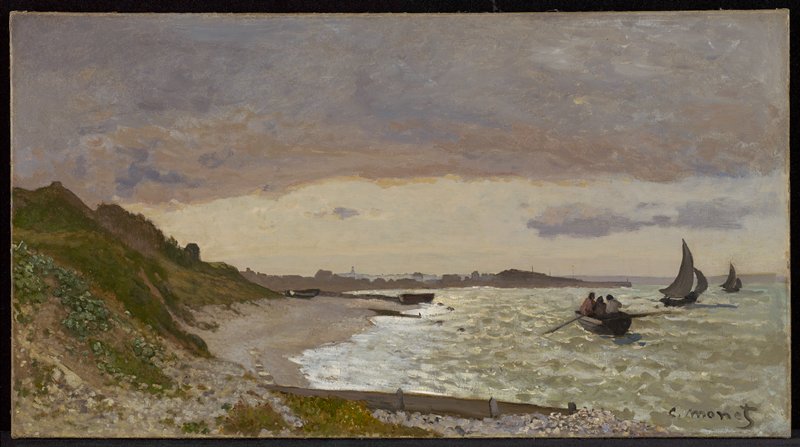
The Seashore at Sainte-Adresse
Early coastal view from Normandy shows Monet establishing his primary subject: the beach as a stage for the interplay of light, shadow, and water's reflective surface.
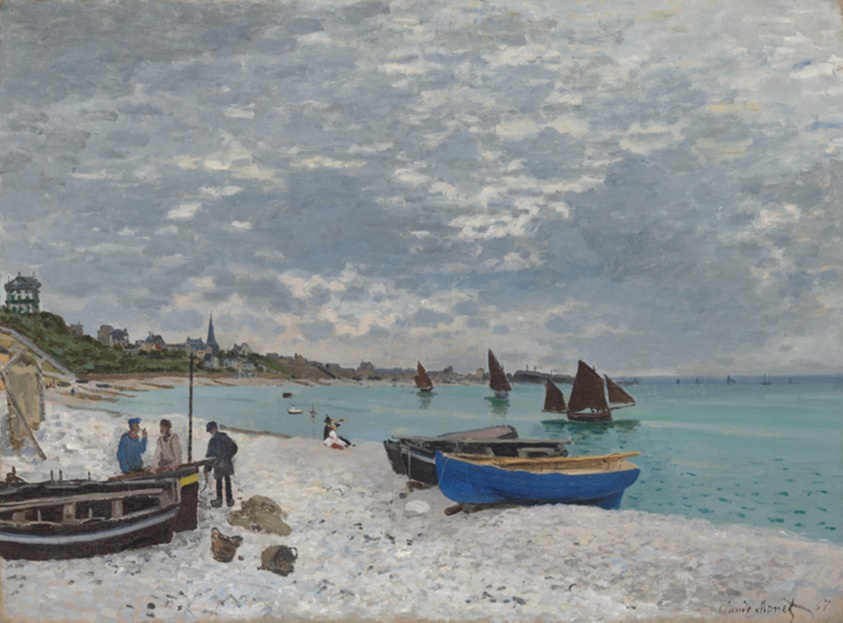
The Beach at Sainte-Adresse
Another Sainte-Adresse painting from three years later demonstrates his accelerating commitment to the same motif, testing how technique evolves when subject matter remains fixed.
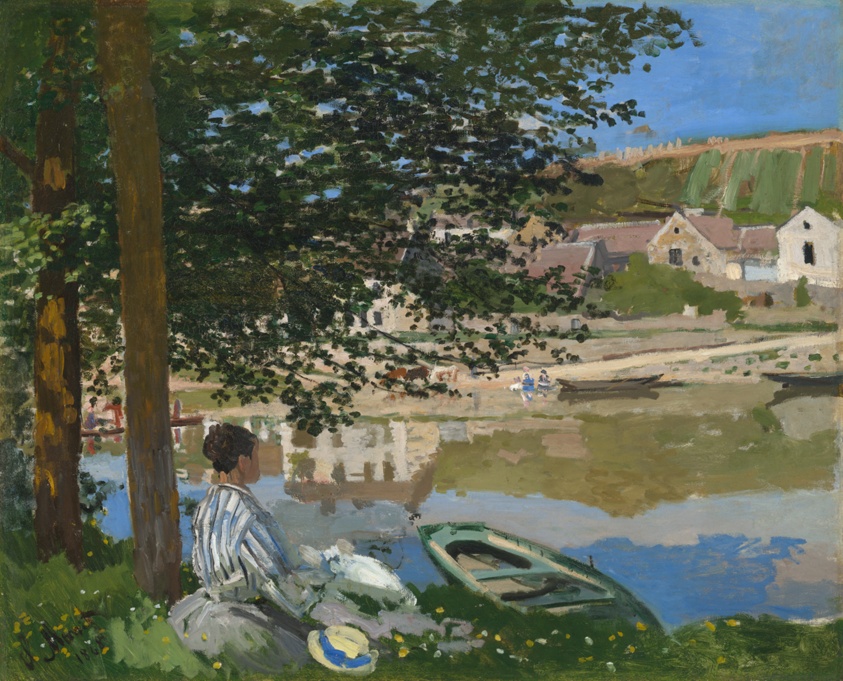
On the Bank of the Seine, Bennecourt
The Seine at Bennecourt shifts attention inland to quieter water, introducing the river as a subject that will recur throughout his career, each time with different light and atmospheric conditions.
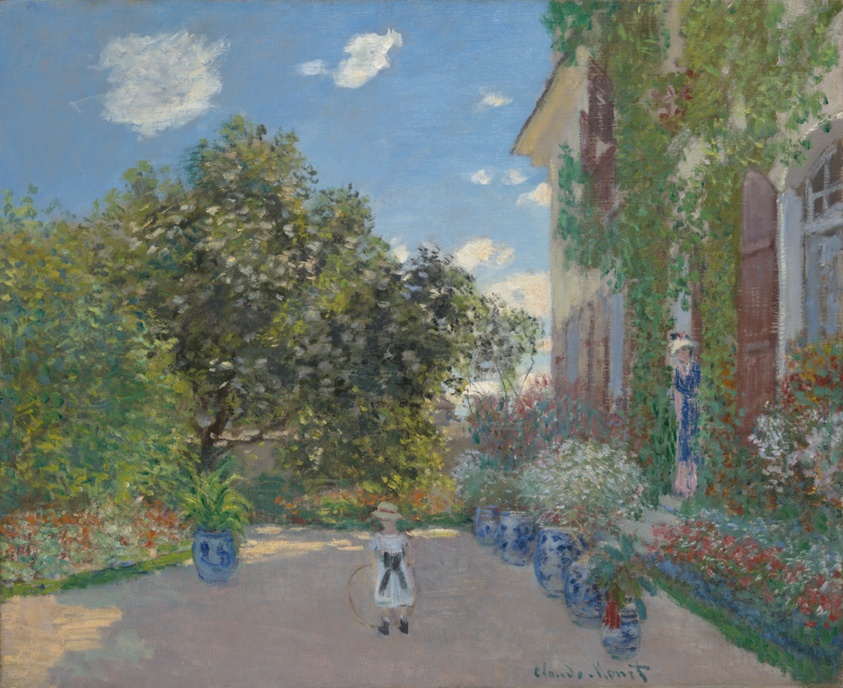
The Artist's House at Argenteuil
The Artist's House at Argenteuil marks a transition: water is no longer merely observed but inhabited, a domestic landscape where Monet begins to paint his own lived environment.
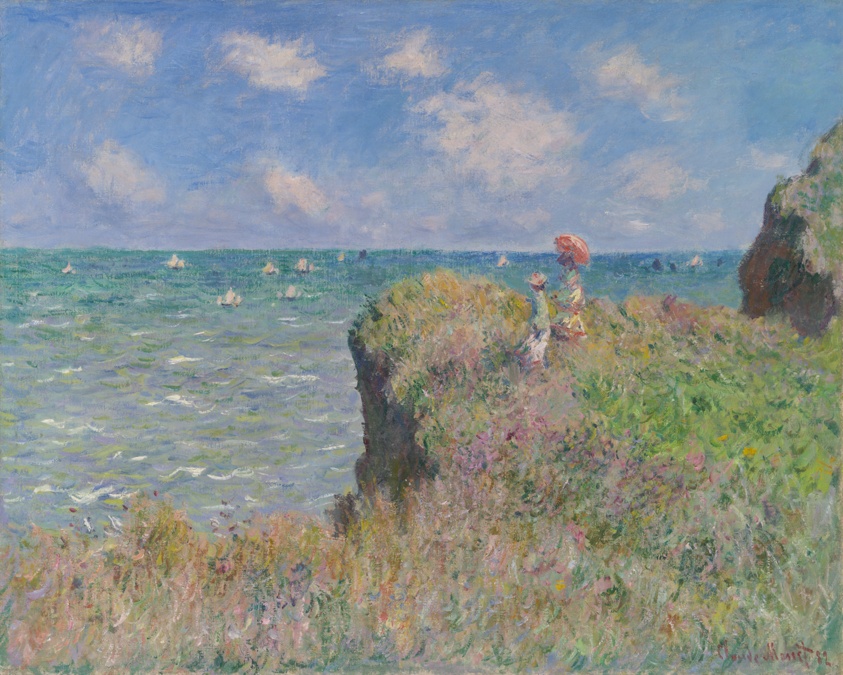
Cliff Walk at Pourville
Cliff Walk at Pourville returns to the Normandy coast with the fractured brushwork fully mature, water rendered as pure chromatic vibration rather than descriptive detail.
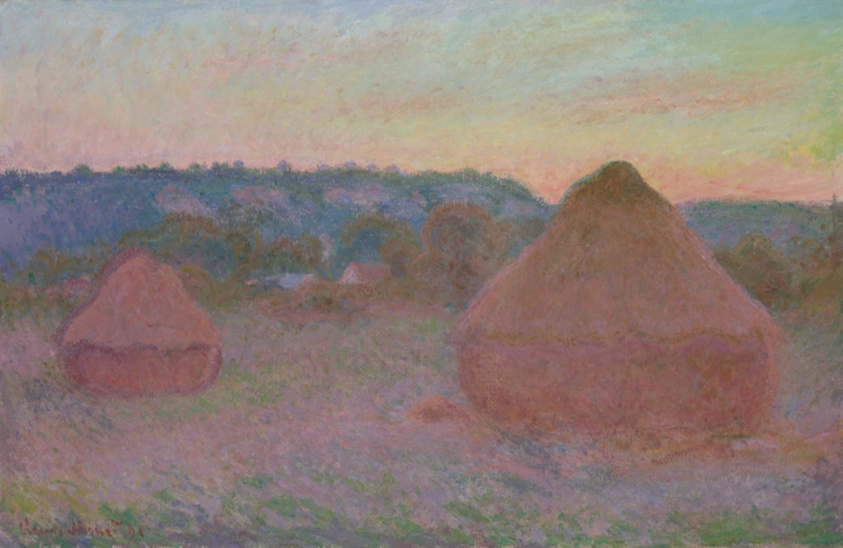
Stacks of Wheat (End of Day, Autumn)
Stacks of Wheat represents a deliberate interruption of the water subject, yet the stack's golden surface and its interaction with light and shadow mirror the formal concerns Monet was applying to water.
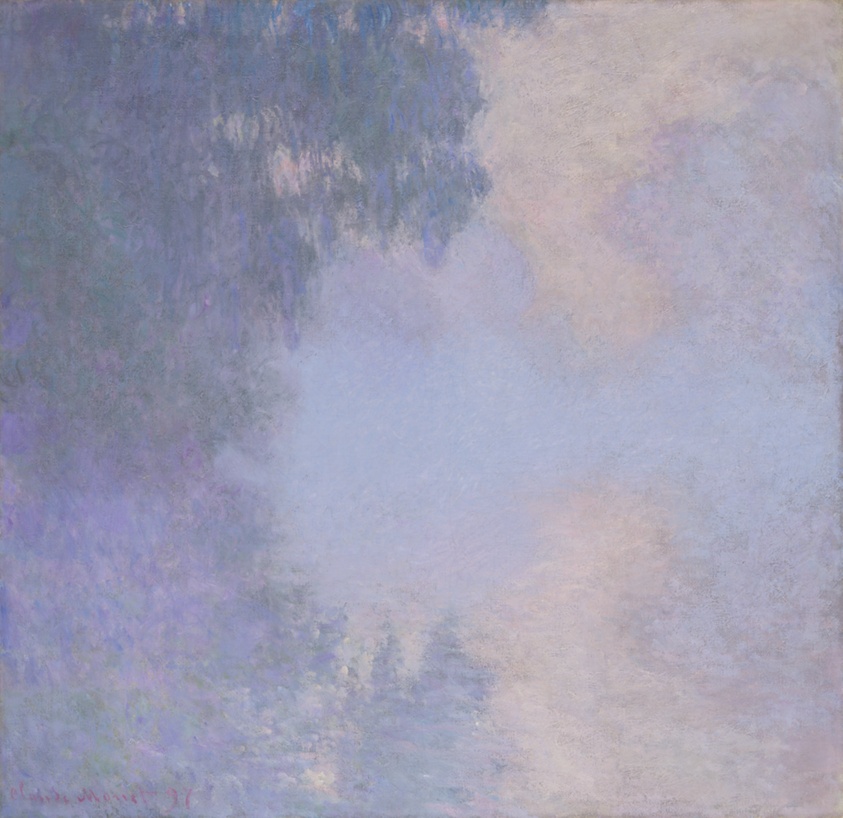
Branch of the Seine near Giverny (Mist)
Branch of the Seine near Giverny (Mist) marks the artist's arrival at his final location, mist dissolving the distinction between water and air, form and atmosphere.
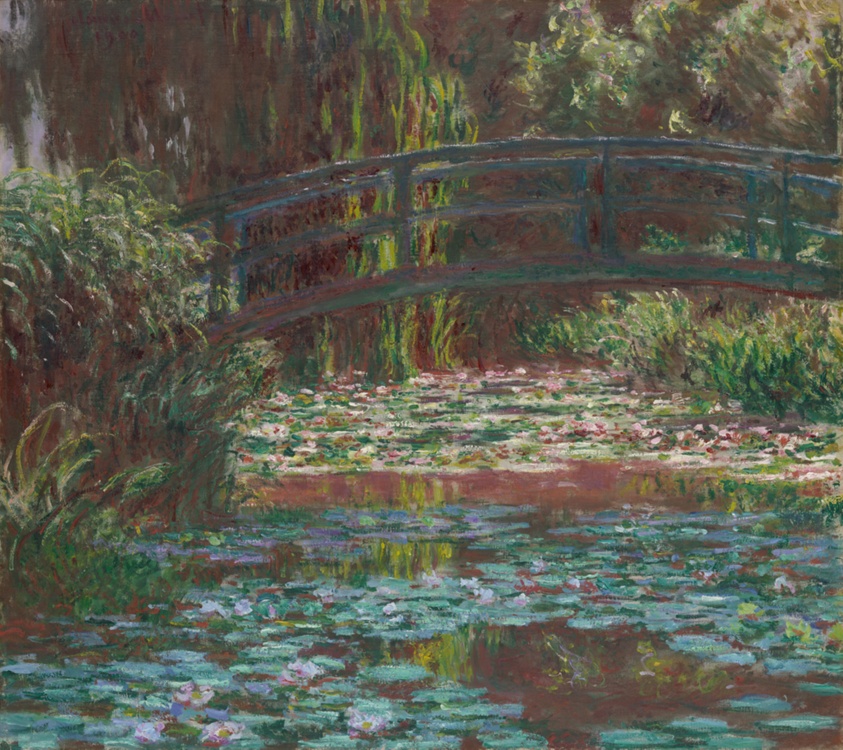
Water Lily Pond
Water Lily Pond from 1900 is the pivot: Monet's own constructed garden pond replaces found nature, freeing him to treat the surface as pure abstraction rather than representation.
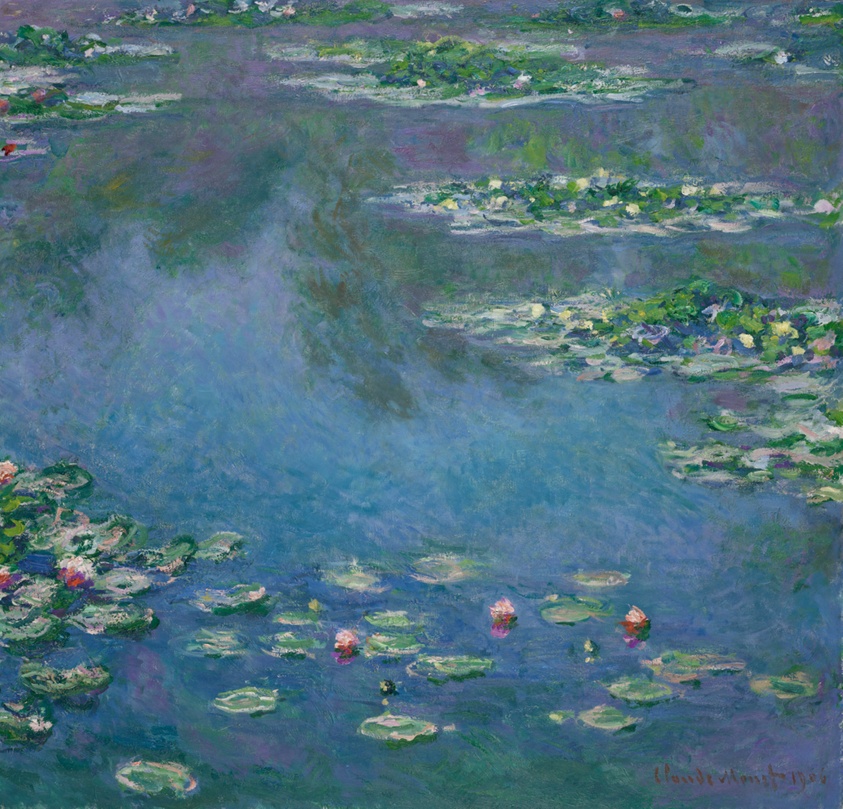
Water Lilies
Water Lilies from mid-career Giverny shows the pond magnified and flattened, individual flowers and reflections competing for visual priority as the surface becomes nearly autonomous.
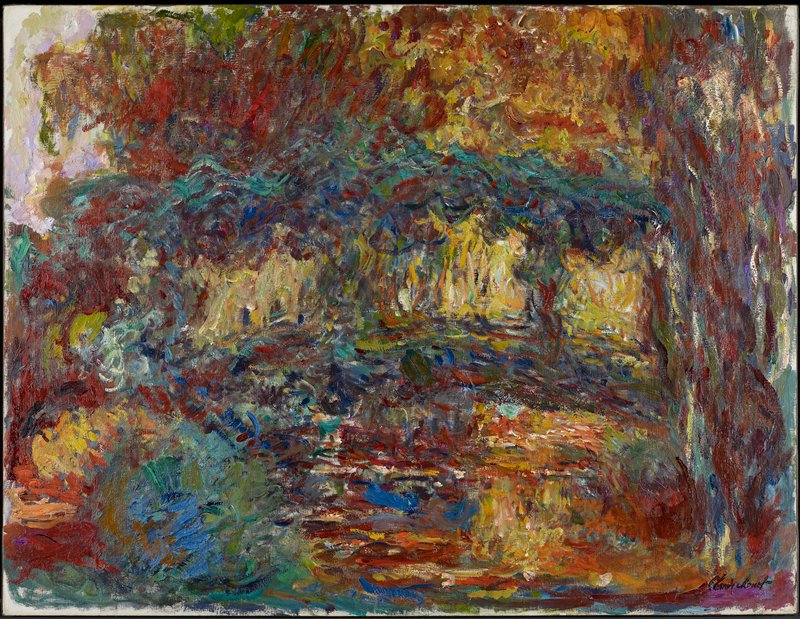
The Japanese Bridge
The Japanese Bridge, painted near the end of his life, shows Monet returning to the constructed elements of his garden with a looser, more gestural hand, light dissolving the bridge into colored brushstrokes.
The Review

A single artist, ten paintings, sixty years of the same problem. The curatorial premise is sound: water as the irreducible variable in Monet's work, light as the thing he chased across every surface. But the show mistakes coverage for argument. It moves through time like a textbook, beginning with the Normandy beaches (The Seashore at Sainte-Adresse, 1864; The Beach at Sainte-Adresse, 1867) and ending in the lily pond, and by doing so, it forecloses the only argument worth making, which is formal rather than chronological.
When Cliff Walk at Pourville and On the Bank of the Seine, Bennecourt hang near each other, something happens that the catalog prose already killed: the eye can measure exactly how Monet's brushwork tightened and loosened around the same problem. In Cliff Walk at Pourville, 1882, the cliffs are still architecture, still bounded by drawn edge. The water below holds form. The paint follows the thing. By On the Bank of the Seine, Bennecourt, 1868, that same river refuses to sit still on the canvas, the reflection unmoors from the thing reflected. But the show doesn't make you see this exchange. It just lets you walk past it in sequence.
The real failure is what the exhibition does not do with the garden works. Water Lily Pond, 1900 is the pivot: a viewpoint lowered so far that the water surface becomes the whole world, horizon dissolved, sky illegible. The paint here is already reaching toward abstraction. By Water Lilies, 1906 and The Japanese Bridge, 1923, Monet has abandoned representation almost entirely. Those paintings are not softer versions of the early work. They are the opposite. They are what happens when an artist stops trying to depict water and starts trying to be water, optically. The brushwork thins into a kind of scumble. The surface becomes transparent to itself. These should have been the center of the show, not the terminus.
Instead, the curator treats the late work as the natural end of an arc, as if mastery deepened into meditation. But Monet's late paintings are not meditative. They are dissolving. They are the work of someone who has finally stopped believing that paint can hold light still and has committed to painting only its movement. That is not sentiment. That is form doing its job. The show misses it by assuming that looking at the same subject for sixty years is the story, when the story is what happens to the eye when it stops expecting to find an ending.
- +Early works like The Seashore at Sainte-Adresse show Monet before the dissolution, with water still readable as landscape, allowing the later paintings real contrast.
- +The formal materials are honestly present: the shift in brushwork density from Normandy paintings to Giverny is visible and real.
- +No padding with other artists or mediums; the show commits fully to the single obsession.
- –Chronological ordering neutralizes the formal argument instead of sharpening it; the paintings should be grouped by optical problem, not decade.
- –The late lily pond and bridge paintings are treated as the culmination of a trajectory when they are actually a break from representation; this conflates surface with sentiment.
- –No acknowledgment of what the eye actually does when paint thins to the point of illegibility, as if abstraction here were a softening rather than a rejection.
- J.M.W. Turner →Predecessor in the sustained investigation of light and atmosphere as primary subjects, using broken brushwork and dissolving form to render weather and water.
- Agnes Martin →Later artist who, like Monet's late work, pursues abstraction through the patient repetition of simple surfaces and subtle variations in tone and gesture.
- Helen Frankenthaler →Explicitly engaged with Monet's late water lilies as a model for how to flatten, abstract, and make the painting surface itself the subject.

The organizers of this exhibition have had the good sense to resist the temptation to clutter a single-artist show with borrowed works meant to contextualize or correct. What we have instead is a disciplined selection drawn from two institutions, ten canvases spanning six decades of Monet's output, arranged as a vertical inquiry into method rather than a horizontal survey. This is a curator's decision I respect, even if the exhibition itself reveals both the necessity and the limitations of such restraint.
One begins with The Seashore at Sainte-Adresse, painted in 1864 when Monet was still testing the possibilities of the motif. The beach recedes toward a horizon that refuses easy perspective; the water is rendered with a palette of greens and grays that show a young painter already aware that water does not photograph itself in single hues. By the time he reaches The Beach at Sainte-Adresse three years later, the handling has grown more assured, the brushwork more economical. These works reveal not a master arriving fully formed but a technician who understood that the sea required a different visual grammar than the pastoral tradition had allowed. The broken touches of pigment accumulate without blending into atmospheric softness; instead they suggest the actual flicker of light across a moving surface.
What demands attention is the interval between On the Bank of the Seine, Bennecourt (1868) and the later river works. In the Bennecourt canvas, Monet places a seated figure in foreground, the composition still anchored to the human scale. The water itself, though capably painted, remains subordinate to the larger pictorial architecture. Then observe what happens when one turns to Branch of the Seine near Giverny (Mist), executed nearly thirty years later in 1897. The figure has vanished entirely. The water has become not backdrop but protagonist, and the handling has grown almost cursive, the brush following the logic of light rather than the demands of form. Where once water was a surface to be depicted, it has become the very subject of depiction itself, the sole thing worthy of the artist's hand. This shift is not incidental; it is the whole question the exhibition asks.
The wheat paintings, most notably Stacks of Wheat (End of Day, Autumn) from 1890, make an awkward guest here. The work is undeniably accomplished, its surface alive with the warm orange and violet harmonies for which Monet is rightly celebrated. Yet the premise of the show stumbles against it. These are not water paintings, whatever the curator's good intentions in positioning them as studies of light's effect on any surface whatsoever. Wheat stacks do not move; water does. The fundamental instability that makes water such an exacting subject is absent, and the inclusion feels like an argument constructed after the fact rather than discovered in the work itself.
The Giverny canvases present their own peculiar challenge. Water Lily Pond from 1900 and Water Lilies from 1906 show a painter who has engineered his own subject, constructed a garden specifically to paint it. The flat plane of the pond, the Japanese bridge, the willows reflected in the surface, all of it is Monet's own design. Yet in Water Lilies, the later work, the touch has grown so broken, so nearly abstract in its dissolution of recognizable form, that one struggles to locate the motif beneath the handling. The surface of the painting has become nearly coterminous with the surface of the water itself. This is either profound mastery or elaborate confusion, and the exhibition does not fully clarify which. The pigment lies on canvas in colors and combinations that do not quite resolve into a stable image; the eye cannot rest. Whether this represents the culmination of the artist's method or its exhaustion remains an open question, and the curator has not ventured an answer.
The Japanese Bridge, painted in 1923 when Monet was in his eighties and his vision severely compromised by cataracts, shows the hand still moving with precision even as the color relationships grow more violent and uncertain. The bridge itself emerges from streaks of mauve and deep blue, the water rendered as pure chromatic incident rather than optical fact. One recognizes what the painting represents only because one has been trained by decades of seeing Monet to find the motif within the abstraction. This is a painting made by a man who has earned the right to dissolve his subject, having spent a lifetime in its company.
The exhibition succeeds in demonstrating that Monet's investigation of water was not sentimental but systematic. The evolution is visible not as progress toward greater authenticity but as a gradual subordination of descriptive purpose to the raw fact of pigment itself. Whether this trajectory deserves the philosophical weight the exhibition catalogue appears to assign it is another matter. The work speaks for itself with sufficient clarity that one need not enlarge it into a metaphor for perception or consciousness or the irreducibility of the visible world. Monet painted water because water presented particular technical challenges to which he devoted his life. That is enough. That is everything.
- +The early Normandy paintings demonstrate a genuine technical evolution from 1864 to 1868, visible in brushwork and chromatic confidence.
- +The Giverny sequence, despite its difficulties, honestly documents the dissolution of legible form under sustained engagement with a single motif.
- +The curation respects the integrity of a single artist without diluting the inquiry with borrowed context or comparative works.
- –The inclusion of Stacks of Wheat (End of Day, Autumn) contradicts the exhibition's premise; wheat does not move, and the argument for its presence appears retrofitted.
- –The final paintings, particularly Water Lilies and The Japanese Bridge, raise more questions about decline or liberation than the exhibition apparatus is equipped to address.
- –The roster is too small (ten works across six decades) to support the ambitious historical narrative; gaps in the middle years leave the evolution only partially documented.