The Body Abstracted
From Cycladic austerity to Cubist fracture to Pop flattening, five artists across three centuries found the human form most expressive when it stopped looking human.
“The body abstracted: from Cycladic marble figurines to Cubist fractured portraits to Pop Art's flattened icons, three moments when artists decided the human form didn't need to look human.”
The body has never needed to resemble a body to register as one. This exhibition traces three distinct moments when artists radically simplified, fragmented, or stylized the human figure not to diminish it but to make it speak more forcefully. Beginning with the marble heads of Cycladic civilization (c. 2700 BCE), where the female form is reduced to a continuous curve and the minimal suggestion of a face, the show moves to the early 20th century, when Picasso, Brâncuși, and Matisse each found ways to abstract the body while preserving its weight and presence. Finally, it arrives at Pop Art's cool, flattened portraits, where Alex Katz strips the human face down to color fields and clean contours, rendering contemporary figures as graphic as any corporate logo.
What connects these works is a shared conviction that representation can become more human by becoming less naturalistic. The Cycladic figurine is not an incomplete attempt at realism but a complete formal statement. The Old Guitarist is not a broken figure but a restructured one, its blue tones and fractured planes generating more melancholy through abstraction than any academic rendering could. Brâncuși's Mademoiselle Pogany achieves an almost abstract purity while remaining unmistakably a portrait. Katz's Vincent and Tony are flattened, but they are flattened into legibility, not away from it.
Each period's abstraction reflects its own moment: Cycladic simplicity speaks to ritual and the divine; Cubist fragmentation responds to the destabilization of certainty in modern consciousness; Pop's clean surfaces mirror mass production and the commodification of identity itself. Together, these seven works argue that the human form has always been an invention available for reinvention.
Walk through in order, 7 works.
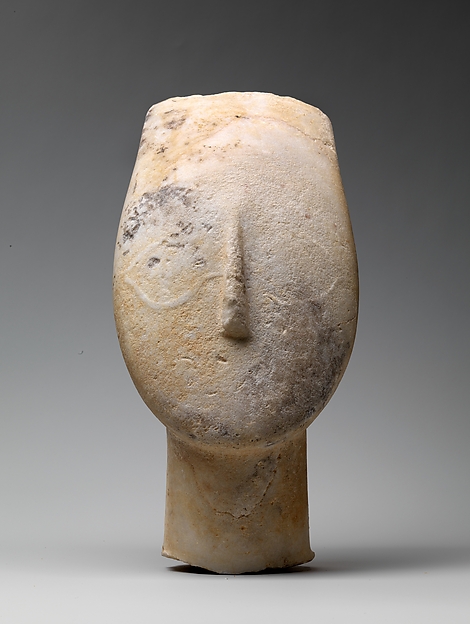
Marble head from the figure of a woman
This 4,700-year-old marble head establishes the exhibition's founding premise: the female face reduced to a single continuous curve, eyeballs inlaid rather than carved, a form so spare it feels more present than any photographic likeness could be.
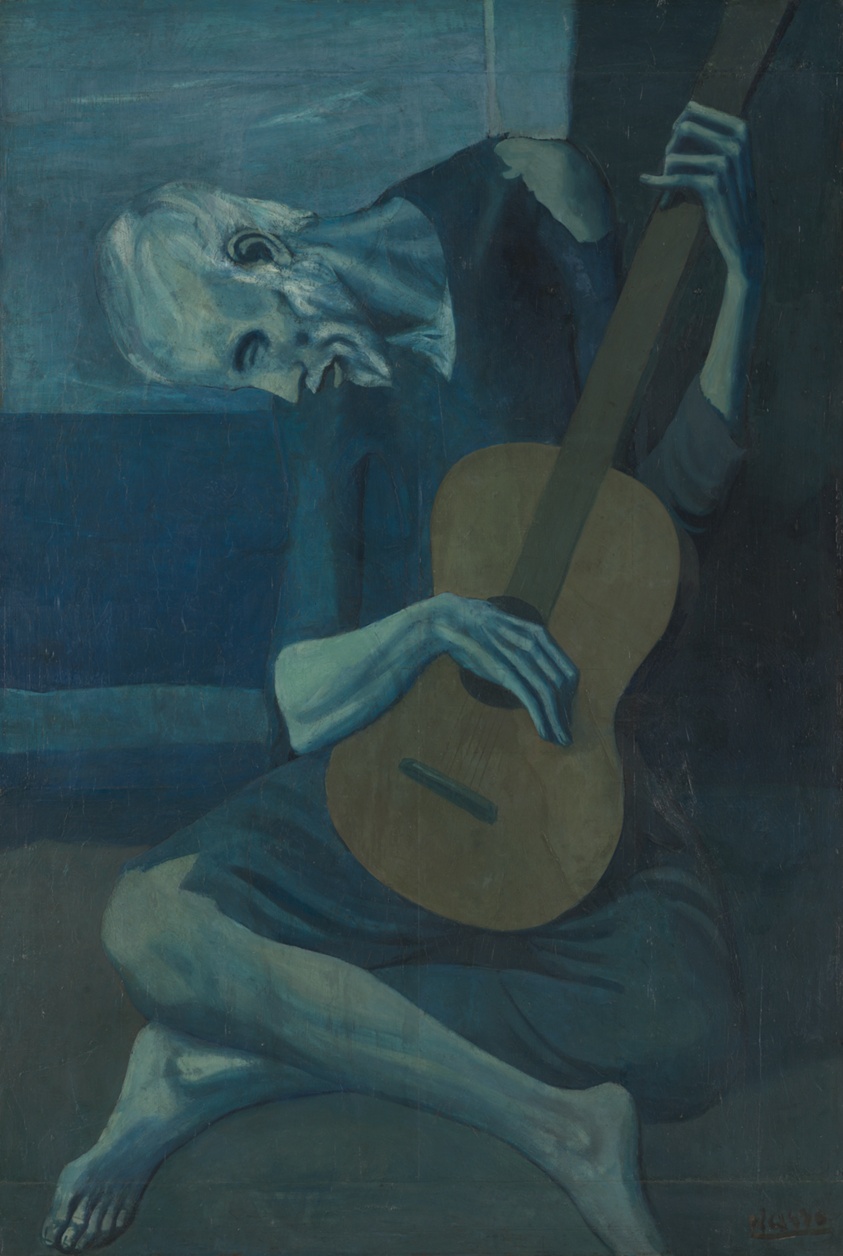
The Old Guitarist
Picasso's bent figure, rendered in monochromatic blues and fragmented planes, abstracts the body not through removal but through structural rupture, each shard of the old guitarist's form expressing grief more acutely than naturalism ever could.
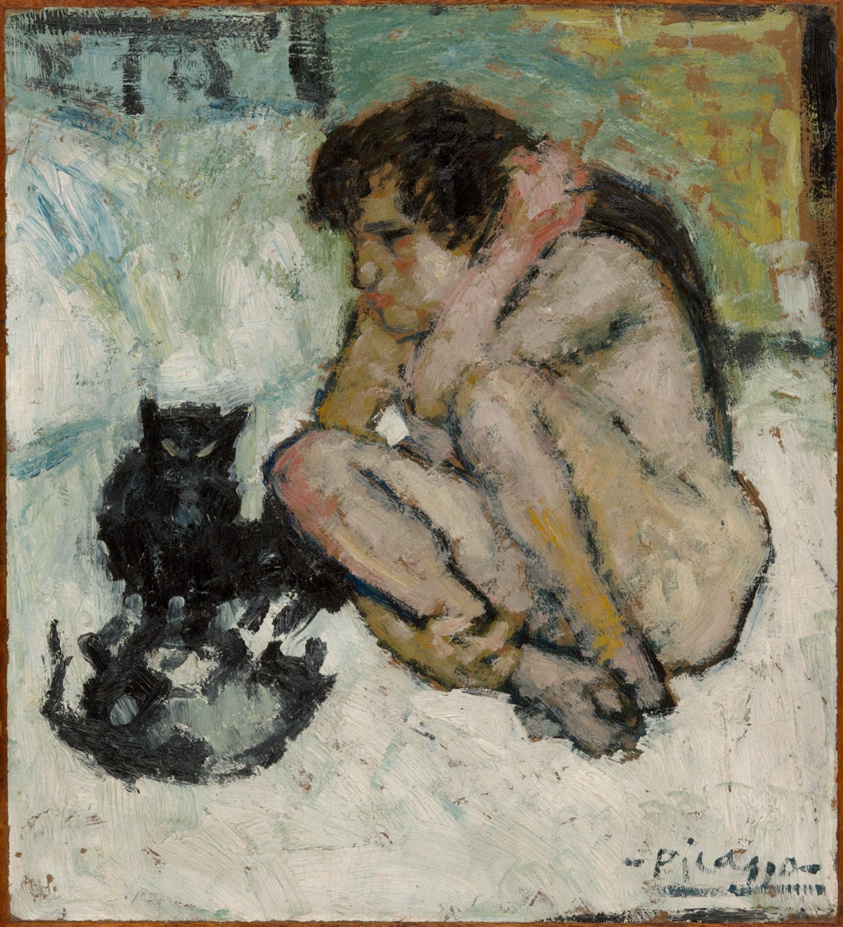
Nude with Cats
A seated figure seen from above, dissolved into loose gestural marks, holds its shape through color and contour alone; the cat anchors the composition in domestic space while the woman's body becomes an almost incidental arrangement of warm tones and dark accents.
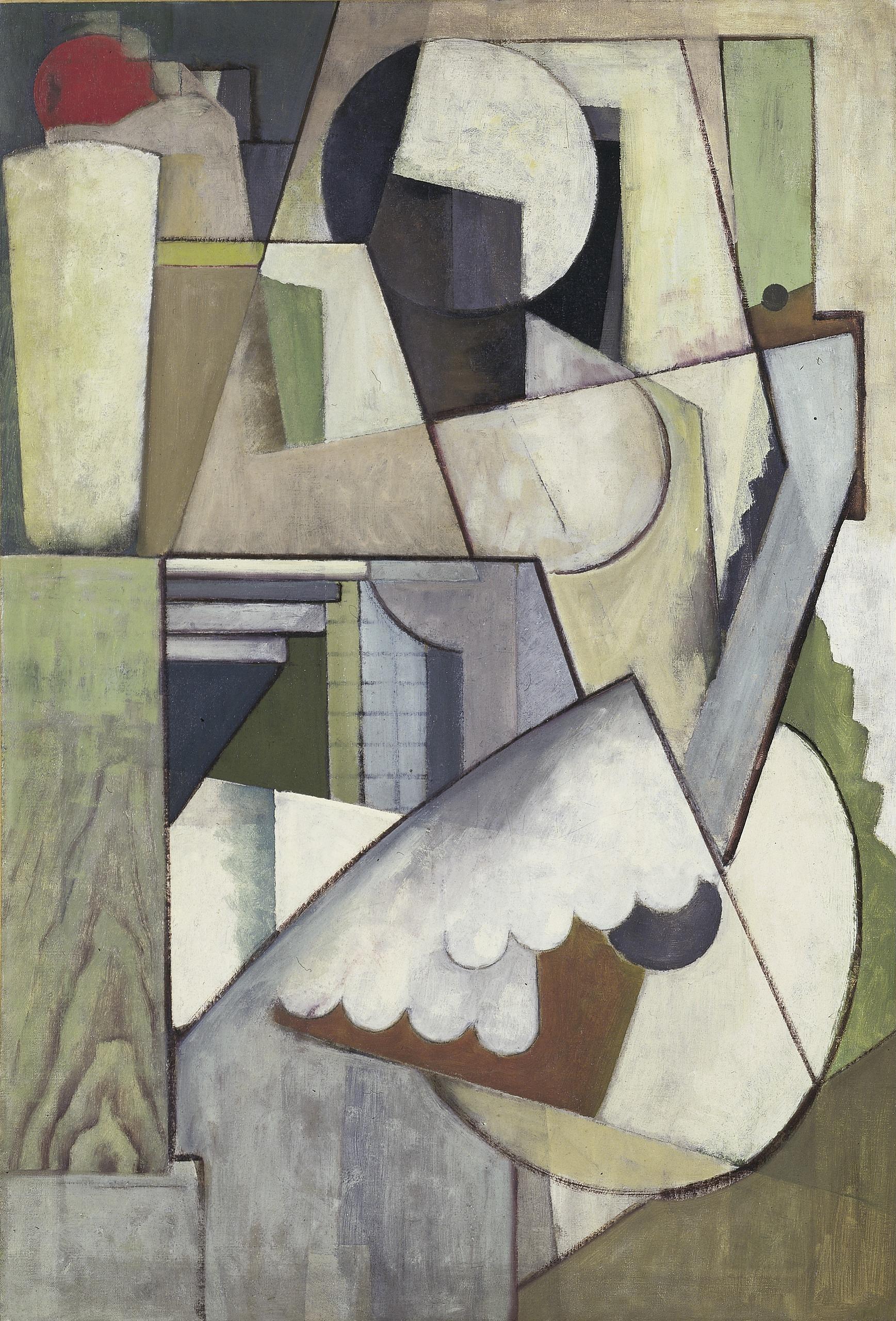
Figure with Guitar II
Taylor's angular, geometric fragmentation of the seated musician shows American Cubism in full earnest, every plane of the figure locked into a rigid, constructive grid that leaves barely a trace of the body's natural proportions.
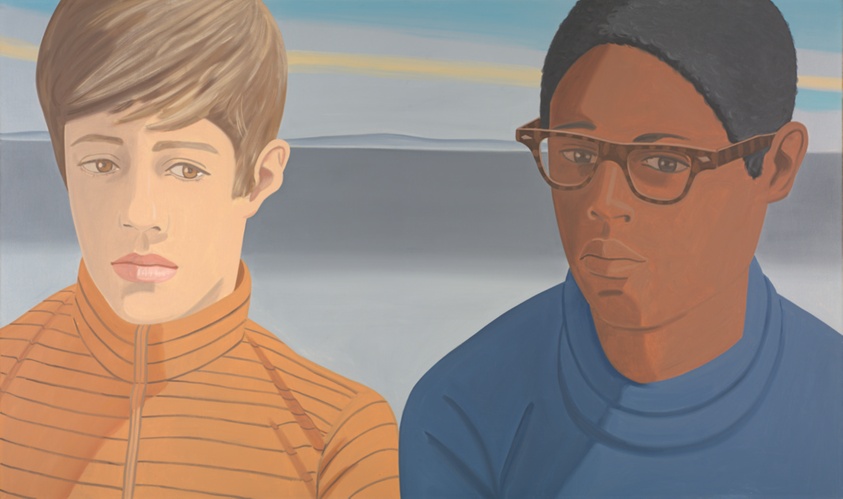
Vincent and Tony
Katz's twin portraits flatten the face into clean zones of color and line, rendering contemporary identity as a product of pigment and carefully placed form, as though a person could be constructed entirely from a paint manufacturer's palette.

Mademoiselle Pogany
Brâncuși's polished bronze head achieves near-total abstraction while preserving the unmistakable fact of portraiture; the smooth ovoid and the decisive horizontal cut of the eyes transform a human face into pure form without erasing its force.
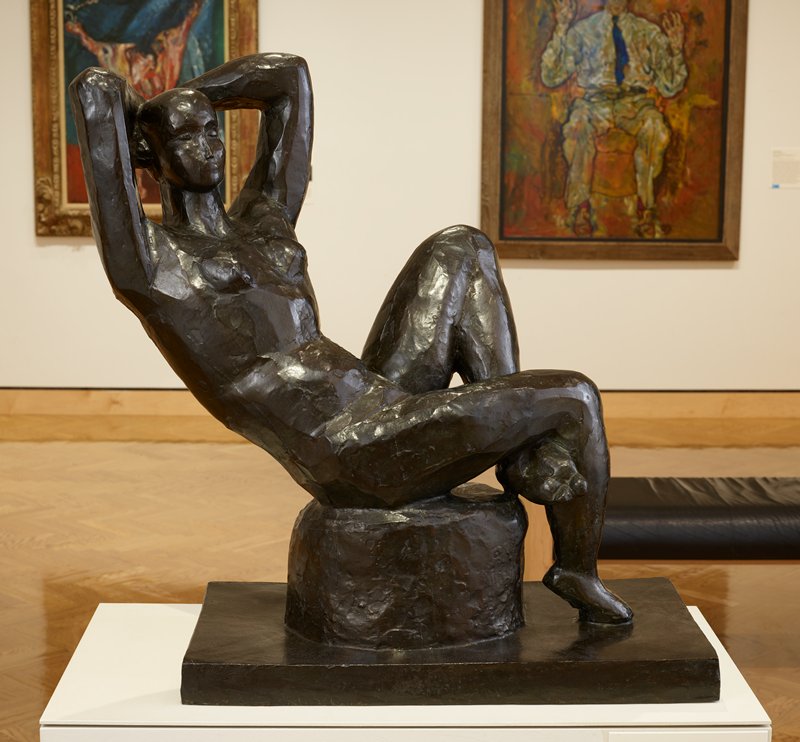
Large Seated Nude
Matisse's reclining bronze figure, modeled directly in clay and cast in bronze, simplifies the body to its essential structural planes; the frontal torso and the gesture of the raised arm condense female nakedness into something monumental and impersonal.
The Review

The show's strongest moment arrives between the Cycladic head and the Old Guitarist, where you can see the form of abstraction itself shift. The marble is timeless by accident; it abstracts because the material demanded it and because the maker understood that a face needs almost nothing to be legible. Picasso's guitar player is abstract by will, by a decision to fragment the body in order to show its internal shape. Two different propositions about what abstraction does to the figure.
The Cycladic head, even after 4,700 years, holds you. It is almost featureless, yet it commands. The eyes are simple elongated cuts, the nose a ridge, the mouth absent. What remains is pure profile and surface. There is no sentiment in it. This matters because it sets the standard for what comes after: abstraction that does not ask to be forgiven for what it removes.
Picasso's The Old Guitarist works because the blue is cold enough to contain the sorrow without expressing it. The figure is folded, cracked, reassembled in a way that honeys the body's vulnerability. The guitar is more solid than the musician. This is compositional genius, not sentiment disguised as form. Every edge serves.
Brâncuși's Mademoiselle Pogany is the show's most complete work. The bronze is so polished it becomes abstract without losing the fact of portraiture. The smooth ovoid, the precise cut for the eyes, the overall reduction of a face to something that resembles an egg more than it resembles a woman, yet it reads as a portrait. The finish is everything. A rougher cast would collapse into decoration. This one sustains itself entirely through the relationship of curved surface to incised line.
Matisse's seated nude is less successful. The simplification is there, but it reads as simplification rather than as a complete formal statement. The raised arm works structurally, but the overall composition feels more like a sketch that was cast rather than a form that was conceived for bronze. Compare it to the Brâncuși and the difference is clear: one is an idea realized in its truest material form, the other is a drawing that has gained weight.
The Cubist experiments by Picasso and Taylor show abstraction in its more aggressive mood. Taylor's Figure with Guitar II is almost willfully severe in its geometry, every angle locked down, the figure barely visible as a human thing. It is less elegant than Picasso's earlier work but more consistent in its logic. The picture plane is a grid. The body is an accident within it. You admire the discipline.
Katz's portraits at the end of the show are clean but thin. The abstraction here is not structural but graphic: the face flattened, the color simplified, the figure rendered as though it were a silkscreen. The work is competent and formally sound, but it feels like a different kind of abstraction altogether. Not reduction but flattening. Not compression but thinning. It makes its point about pop culture and identity, but it does not sustain itself the way the earlier works do. The surface tells you what to think rather than asking you to work.
- +Brancusi's Mademoiselle Pogany sustains an almost perfect balance between abstraction and portraiture, every element of the bronze essential to the whole.
- +The Cycladic head establishes a radical precedent that everything after it measures against, a 4,700-year-old proof that abstraction requires no justification.
- +The formal range across media (stone, bronze, oil, metal) is genuine, and the comparative study of how different materials demand different kinds of simplification is sharp.
- –Matisse's seated figure reads as a sketch cast in bronze rather than a form conceived from the ground up for the material, leaving it structurally weaker than its neighbors.
- –The Katz portraits feel like a different category of abstraction, graphic reduction rather than structural reformation, which weakens the show's overall argument about what abstraction achieves.
- –The curatorial jump from Cubism directly to Pop elides the decades of abstraction and figuration in between, making the final gesture feel almost arbitrary.
- Henry Moore →Moore's abstract bronze figures of the mid-20th century pushed the Brancusi model further toward pure biomorphic form while maintaining the figure's legibility.
- Art Brut →Raw, immediate figuration that rejected both naturalism and formal refinement offers a productive counterpoint to the controlled abstraction on display here.
Curious what another critic would make of this show?