About Ellsworth.
The project

Ellsworth is a personal project created and designed by Daniel Hamilton and built for educational and research purposes. It connects open-access artwork data from museum collections and consolidates them into a single, searchable intelligence layer, with tools to discover movements, trace influence, and interact with the collection in ways no single museum could offer on its own. It's intended to encourage exploration, learning, and a deeper understanding of art history through its many themes, stories, and connections.
Writing
I believe Ellsworth offers educators, researchers, students, and art history lovers new ways to stimulate curiosity, develop and refine critical thinking skills, and engage more deeply in intellectual discussion when framed through the perspectives of art critics. I learned this for myself in Art History courses through slide memorization and by reading and writing critical essays. Ellsworth's agent critics are crafted with their own unique artspeak, experiences, emotions, philosophies, and narrative voices inspired by real artworld critics, philosophers, and curators.
If you're into it, I also write about the project on hamilton.studio as I continue to build it.
October 9, 2026
Ellsworth: Hear 700 Years of Color, and See Paintings at Their Real Size
Four new studies, a soundtrack you can download, visitor-curated exhibitions with critics, and artist profiles rebuilt for accuracy. What's new on Ellsworth since July, and how to use each piece.
July 5, 2026
Building Ellsworth: A Progress Report
Visualizations, museum data, and a real accessibility pass. What's shipped so far on Ellsworth, my AI-powered art history project.
June 20, 2026
On Ellsworth
The connections were always there, they just weren't as visible.
Data & sourcing
Museum artwork data is provided under open access terms. Wikipedia & Wikidata content is licensed under CC BY-SA 4.0. Biographical facts such as birth and death years, nationality, and movement affiliations are sourced from Wikidata and museum records. The full list of sources, how colors are measured, and the rules every view follows are on the Methods & data page.
AI-generated content
Artist and movement profiles, including pull quotes, biographical text, and data stories, are written by Claude Opus 5.5 (Anthropic) from each artist's Wikipedia article and the museum records of their works, and are checked for accuracy by sampling. They can still contain errors and may not reflect scholarly consensus. If you spot one, use the “Report an inaccuracy” link beneath the profile. Exhibition reviews in the Play section are also AI-generated, written by a panel of agent critics.
Accessibility
Ellsworth targets WCAG 2.2 Level AA, verified through a full remediation pass covering landmarks, headings, focus management, keyboard navigation, dialog semantics, color contrast (including icon-only controls), and support for reduced-motion preferences.
Every route below is checked automatically before anything ships: a Playwright + axe-core suite (24 tests, every route in both light and dark) runs against the full site, and Lighthouse accessibility audits are re-verified whenever a change touches shared layout or global styles.
Home100
Figures100
Movements96
Works100
Events100
Palettes100
Exhibitions96
Exhibition builder100
Critics100
This page100
The two 96s share one cause: palette-color swatch buttons on card listings sit under the 24×24px minimum touch-target size (WCAG 2.5.8), which is tracked for a fix. Everything else on those pages passes clean. Detail-page templates (artist, exhibition, event) are covered by the same automated suite, not listed individually above since each renders different content per page.
Last verified: September 2026.
Feedback & bugs
This project is intended for art education and research and is growing constantly. If you find inaccuracies or bugs, use the Bug Reporter in the lower right of the page to share them. I read every one and will address it. I hope you have fun and learn something new!
Recent updates
2026-10
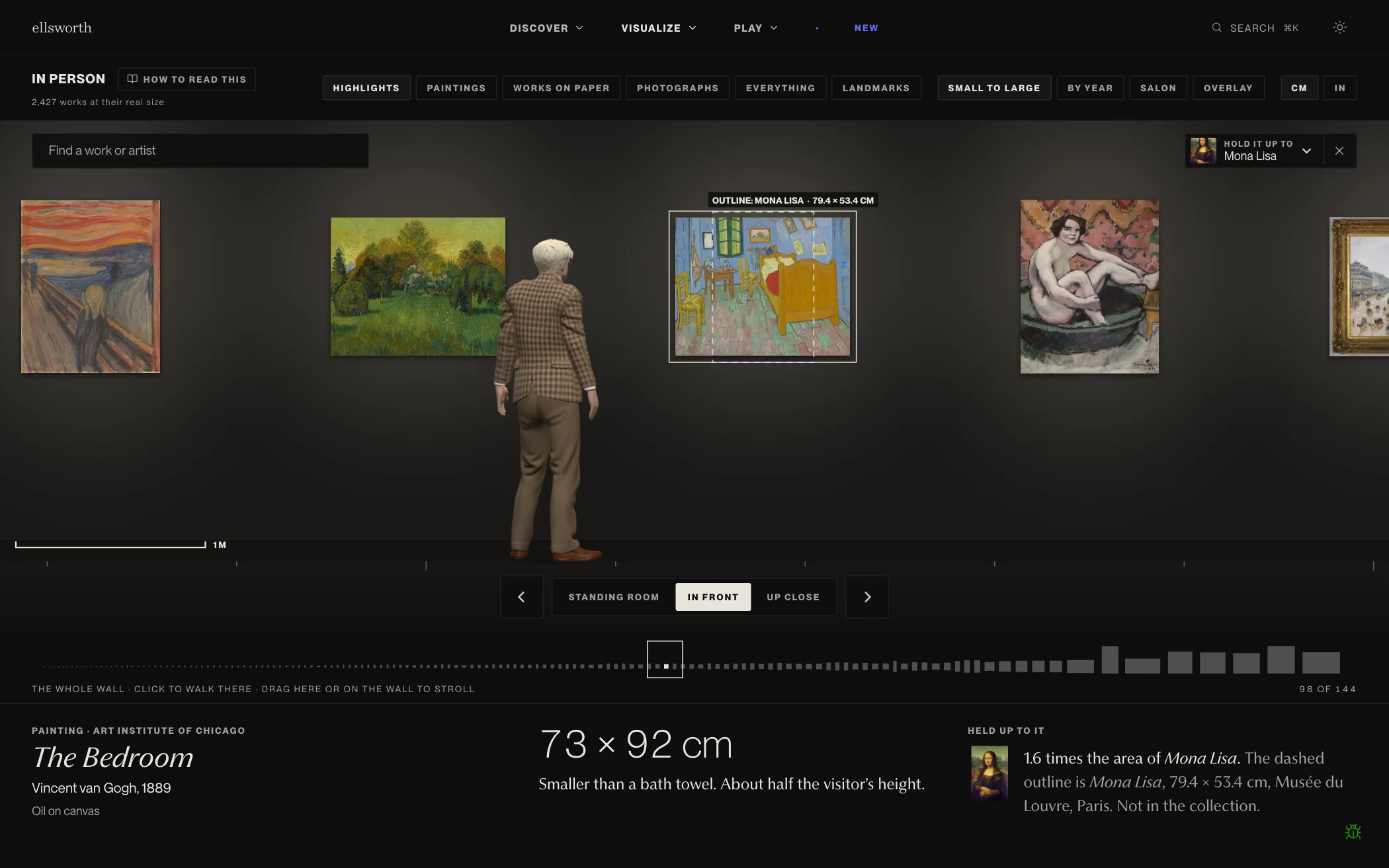
New study, In Person: the collection hangs at its real size beside a visitor 170 cm tall. Walk the wall, step back or up close, switch to a floor-to-ceiling Salon hang, and hold the Mona Lisa or another famous painting up to any work as a dashed outline at its true size. A work hangs only when its photograph’s proportions agree with its recorded dimensions.
2026-10
New study, Pigment Weather: seven centuries of paintings as a river of 14 color families, pinned with the years pigments like Prussian blue, cadmium red and acrylic reached artists. Select a period to read its percentages and see the works where each color runs deepest.
2026-10
New study, Career Ribbons: every dated painting by an artist, reduced to its colors and woven into one ribbon across a lifetime. Line careers up by year or by age, and open guided stories like Picasso turning blue or Turner dissolving into light.
2026-10
New study, Contemporaries: every artist’s life as a thread. Scrub or play through time to see who was alive at once and how old they were, and pick any two artists to see whether their lives overlapped.
2026-10
Hear the palette: Pigment Weather and Career Ribbons play as music, with lightness setting pitch and saturation setting tone, following research on how people match color to sound. Any of it downloads as WAV audio or MIDI for your own music software.
2026-10
A new Methods & data page and a “How to read this” panel on every study explain where the works come from and the rules every view follows.
2026-10
Artwork records checked across the catalog. Paintings dated after their artist died are kept out of the studies, duplicate artists and works imported twice are merged, and 18 dead image links were replaced or cleared. Works removed by request or found misattributed now stay removed, even when a museum’s data is imported again.
2026-10
Artist and movement profiles were rebuilt for accuracy. Each is now written from the artist’s Wikipedia article and the museum records of their works in the catalog, instead of from a name and dates alone, and describes people by what they actually made: a luthier is no longer called a painter. Where little is recorded, the profile is short and says so. Profiles are written with Claude Opus 5.5 and stored, so every visitor reads the same text. In a claim-by-claim fact-check of a sample, the share of claims contradicted by sources fell from 16% to under 2%.
2026-10
Every profile now names the sources it was written from and has a “Report an inaccuracy” link underneath, so corrections can come straight from readers.
2026-10
Corrected artist records across the catalog: nearly 90 recorded genders that disagreed with Wikidata, several birth and death dates, a handful of artists linked to the wrong person entirely, and about 250 artwork dates that were really the artist’s birth year carried over from museum records.
2026-09
Custom exhibition requests are smarter and more accurate: freeform prompts now recover gracefully instead of returning no results, and thousands of artworks were individually tagged for subject/theme so a themed show pulls in pieces that actually depict it, not just anything by a loosely-associated artist.
2026-09
Added a real accessibility breakdown, with current Lighthouse scores per route in the Accessibility section above, instead of just a footer badge.
2026-09
Exhibitions redesigned: a guided step-by-step curation wizard, critic-scored roster review, and easier navigation back to the exhibitions overview from anywhere in the flow.
2026-09
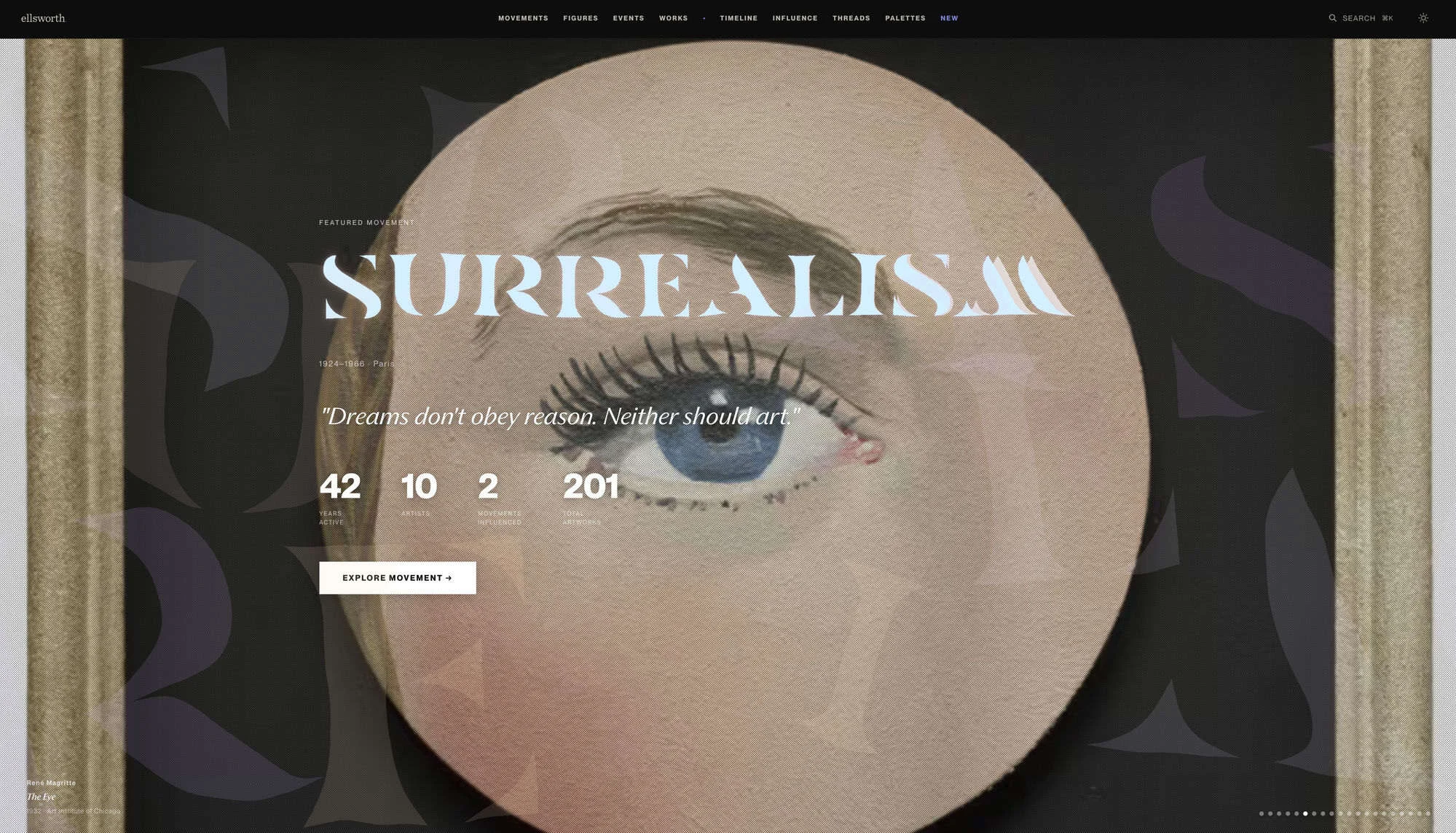
Landing page redesigned around a full-bleed collection hero and a consolidated Discover / Visualize / Play overview.